Table of Contents
- What does a company specializing in AI agents do?
- What to evaluate before hiring an AI agent company
- What information can the agent work with?
- What tools can it use?
- Can it perform actions or only answer questions?
- How are its permissions and limits defined?
- What happens when the agent does not know what to do?
- How do you evaluate whether it works correctly?
- Best AI agent companies in Argentina
- Globant
- IBM
- Accenture
- Tuxdi
- Deloitte
- Comparison of AI agent companies
- A concrete example: what developing an enterprise agent means
- Which AI agent company should you choose?
- What is the agent's objective?
- What information does it need?
- What actions should it perform?
- What are the exceptions?
- How much autonomy does it need?
- How to start an AI agent project
- A demo is not the same as an agent working in production
- Conclusion
- Frequently asked questions
- What is the difference between a chatbot and an AI agent?
- Does an agent need to connect to an ERP or CRM?
- Should you choose a platform or custom development?
- Does an agent need full autonomy from the start?
- How should you evaluate an AI agent company?
If a company is considering implementing AI agents, one of its first decisions will probably be who can develop a solution that works within its actual business processes.
Because an enterprise agent is more than a chatbot.
It can interpret a request, retrieve information from different systems, use tools, make decisions within defined limits, and carry out authorized actions.
For example, consider a message like:
“The invoice is still marked as unpaid, but we made the transfer on Tuesday. Could you check it?”
An agent could identify the customer, query the ERP, check recent invoices and payments, cross-reference the information, spot a possible discrepancy, and prepare a reply. Depending on its permissions, it could also update information or hand the case to a person when an exception arises.
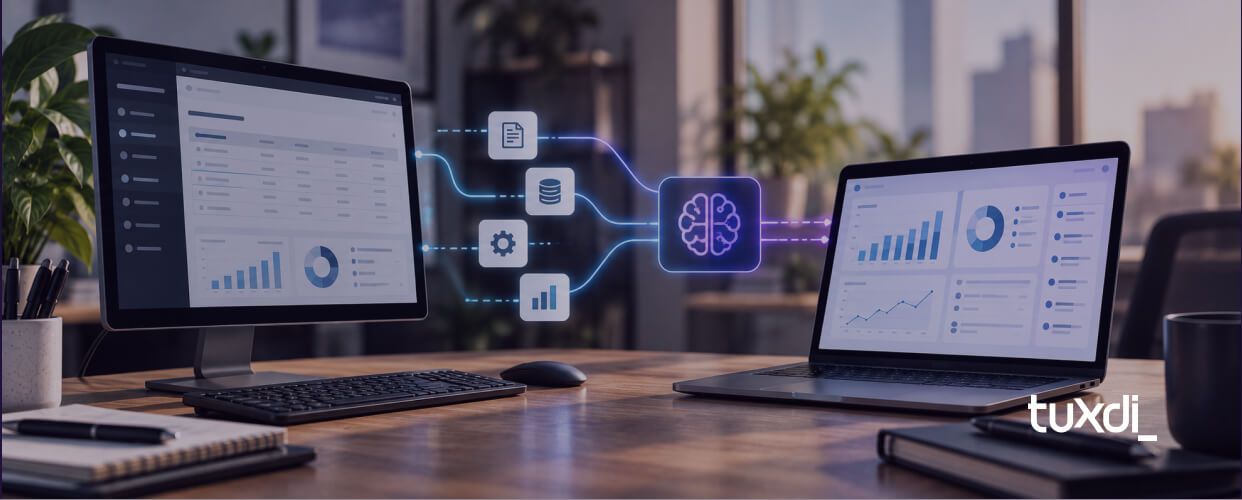
Building these agents requires combining artificial intelligence with integrations, software, data, permissions, security, and knowledge of business processes.
In Argentina, there are several ways to do this. Some providers are global companies offering enterprise AI platforms; others, such as Tuxdi, combine software development, integrations, and custom agents.
In this guide, we look at five AI agent companies with a presence in or the ability to deliver projects in Argentina in 2026, their approaches, and what to assess before choosing a provider.
The order does not represent a ranking. These are options with different scales, approaches, and project profiles.
What does a company specializing in AI agents do?
To understand which provider a business needs, we first need to distinguish an agent from other AI-based solutions.
An assistant can receive a question and generate an answer.
An agent can also work toward a goal, access the necessary context, select tools, and perform actions.
In simple terms:
request → interpretation → context → decision → tool → action → result.
Suppose a sales manager asks:
“Which customers with opportunities open for more than 30 days have still not received a follow-up?”
An agent connected to the CRM could query opportunities, review past activities, identify those matching certain criteria, and prepare next steps.
With the right permissions, it could even create tasks for sales representatives.
The key is that it does more than generate text: it participates in a process using the company's information and tools.
Developing AI agents for businesses therefore usually means addressing four components:
- what information they can access;
- what tools they can use;
- what actions they can perform;
- under which conditions a person must intervene.
What to evaluate before hiring an AI agent company
Comparing providers only by the language model they use tells you very little about the final implementation.
OpenAI, Anthropic, Google, Meta, and other providers offer increasingly capable models. The real business challenge often lies around the model: context, integrations, tools, permissions, exceptions, and production operations.
Before choosing an AI agent company, consider the following points.
What information can the agent work with?
An isolated agent knows little about a business.
To be useful, it may need access to:
- CRM;
- ERP;
- databases;
- documents;
- emails;
- internal systems;
- APIs;
- ecommerce platforms;
- administrative tools.
This does not mean it should access all available information.
On the contrary, each agent should receive only the context required to fulfill its function.
What tools can it use?
Retrieving information is only part of the job.
An agent may need tools to send an email, update a record, generate a document, create a task, query an external system, or initiate another process.
The ability to integrate these tools is an important difference between a prototype and an agent that can actually become part of operations.
Can it perform actions or only answer questions?
This should be defined from the beginning.
An agent can operate at different levels of autonomy.
For example:
Level 1 — Retrieval
Finds information and responds.
Level 2 — Recommendation
Analyzes information and suggests an action.
Level 3 — Execution with approval
Prepares an action that a person must approve.
Level 4 — Autonomous execution
Performs certain actions when predefined conditions are met.
Not every process needs to reach level four. To validate an initial implementation, see our guide on how to test an AI agent.
How are its permissions and limits defined?
Just because an agent can technically perform an action does not mean it should be allowed to.
Changing data, canceling transactions, moving money, or automatically contacting certain customers may require additional controls.
A sound implementation should explicitly define what the agent can and cannot do.
What happens when the agent does not know what to do?
Business processes have exceptions.
A customer may raise an unexpected issue. Information may be missing. Two systems may show conflicting data. An integration may stop responding.
The agent's design must account for these situations.
Sometimes the best decision an agent can make is not to take any action and to request human intervention.
How do you evaluate whether it works correctly?
An agent should not be measured solely on whether it “responds well.”
Depending on the use case, relevant measures may include:
- percentage of tasks completed correctly;
- number of human interventions;
- errors;
- time per operation;
- reversed actions;
- exceptions;
- cost per execution;
- achievement of the defined objective.
This makes it possible to evaluate real outcomes, not just a demo.
Best AI agent companies in Argentina
There are different options for developing or implementing AI agents in Argentina.
The choice mainly depends on the organization's size, the systems involved, the required customization, and the project's scale.
Globant
Globant is a technology company founded in Argentina with global operations and a dedicated enterprise AI and agent offering.
Its solutions include Globant Enterprise AI, a platform focused on building custom agents and agentic processes. It also works with architectures in which different agents collaborate to solve more complex workflows.
In 2026, the company also introduced Glob.AI and its AI Pods: service units in which agents carry out tasks under the supervision of human specialists.
Given its structure and reach, Globant is particularly oriented toward enterprise organizations and large-scale technology projects.
IBM
IBM approaches enterprise agents primarily through its watsonx ecosystem.
With watsonx Orchestrate, organizations can develop agents, connect them to APIs and external tools, establish human approvals, and coordinate multiple agents within a process.
One of its main differentiators is governance: observability, control, permissions, and centralized management of agents deployed in enterprise environments.
This makes IBM particularly relevant to corporate scenarios where governance, infrastructure, and large-scale operations are central to the project.
Accenture
Accenture combines consulting and business transformation expertise with a dedicated offering for developing agentic systems.
Its AI Refinery platform makes it possible to build teams of specialized agents, including agents that break problems into subtasks, use tools, and coordinate other agents' work.
Its proposition is especially aimed at large organizations incorporating agents into broader processes and transformation programs, where the challenge is not just building the technology but integrating it across business functions.
Tuxdi
Tuxdi develops AI solutions combining agents, automation, integrations, and custom software development.
This approach is particularly relevant when an agent must operate within a specific process and connect to systems a company already uses.
For example, a project may require an agent to interpret an email request, retrieve information from an ERP, use data from an internal application, determine the appropriate action, and then update the system.
In these cases, developing the agent also means solving everything surrounding the AI.
Integrations.
The agent can connect to CRMs, ERPs, databases, business platforms, APIs, and existing software.
Custom development.
When a process cannot be handled simply by configuring existing tools, the software components required for integration can be developed.
Permissions and actions.
The project defines which information the agent can access, which actions it can perform automatically, and which require approval.
Progressive implementation.
Full autonomy is not necessarily the goal from day one. An initial version can operate with limited permissions and gradually expand its capabilities as its performance is validated.
This supports projects where the goal is not simply to “have an agent” but to incorporate one into a real business process.
Deloitte
Deloitte approaches agentic AI from a perspective closely tied to business transformation and consulting.
Its initiatives include Zora AI, a platform focused on digital agents capable of participating in complex business functions, alongside solutions developed within its technology partnership ecosystem.
This approach may be especially relevant to large organizations where deploying agents is part of broader initiatives involving finance, operations, workforce, or corporate transformation.
Comparison of AI agent companies
All five companies work with agents, but their profiles differ.
| Company | Approach | Type of project |
|---|---|---|
| Globant | Enterprise AI and technology | Large-scale deployments and agentic architectures |
| IBM | Platform, agents, and governance | Complex corporate ecosystems |
| Accenture | Consulting and multi-agent systems | Large-scale business transformation |
| Tuxdi | Software, integrations, and custom agents | Specific processes connected to existing systems |
| Deloitte | Consulting and agentic AI | Transformation of corporate functions and processes |
This is why there is no single “best AI agent company.”
An organization that needs to deploy hundreds of agents within a global technology architecture will probably have very different requirements from a company that wants to develop an agent connected to its ERP to handle a particular administrative process.
The technology may fall into the same category.
The project may not.
A concrete example: what developing an enterprise agent means
Suppose a company receives hundreds of billing-related inquiries.
A customer writes:
“Invoice 3821 is still marked as unpaid, but we made the transfer on Tuesday. I've attached the receipt.”
A chatbot could generate a response.
An enterprise agent could do something different:
1. Interpret the request.
It understands that the customer is reporting a payment still marked as pending.
2. Identify the customer and invoice.
It uses the message details to find the corresponding transaction.
3. Query the ERP.
It checks the invoice's current status.
4. Check received payments.
It looks for recent transactions associated with the customer.
5. Analyze the receipt.
It extracts the necessary information and compares it with available records.
6. Determine the next action.
If it finds a match, it can prepare the corresponding update.
If it finds a discrepancy, it escalates the case.
7. Request approval when necessary.
A person validates actions with financial implications or those requiring review.
8. Record the outcome.
The resolution is saved in the system.
This example shows a fundamental difference.
The agent's value is not just understanding the message.
It is using that understanding to work within a process.
Which AI agent company should you choose?
It depends on the problem.
Before choosing a provider, answer a few questions.
What is the agent's objective?
Not “adopting AI.”
A concrete goal.
For example:
reducing the time needed to process supplier information update requests.
What information does it need?
It may be spread across a CRM, ERP, documents, emails, databases, or internal applications.
Identifying these sources helps reveal the project's actual complexity.
What actions should it perform?
Retrieving information does not carry the same risk as changing it.
Clearly distinguish:
read → analyze → recommend → modify → execute.
What are the exceptions?
Ideal cases are usually easy.
The real challenge appears when information is missing, data conflicts, or something unexpected happens.
How much autonomy does it need?
Not every agent must operate completely on its own.
For many projects, it makes sense to start with:
interpretation → analysis → proposal → human approval.
Only after validating enough cases should the process move toward:
interpretation → analysis → decision → automatic execution.
How to start an AI agent project
You do not need to automate an entire process from the start.
In fact, a limited implementation can help answer important questions before increasing autonomy.
An initial project may focus on:
- identifying a specific process;
- defining the result the agent should achieve;
- determining what information it needs;
- identifying the systems and tools involved;
- defining which actions it can perform;
- establishing permissions and restrictions;
- determining when a person must intervene;
- testing the agent with real cases;
- measuring results;
- gradually expanding its scope.
This approach helps validate not only whether the technology works but also whether it creates value within the process for which it was built.
A demo is not the same as an agent working in production
Today's models make it possible to build convincing demonstrations quickly.
But a demo answers only part of the question.
It can show that an agent understands a request or knows how to use a tool.
An enterprise project must solve harder questions:
What happens when information is missing?
What if a system does not respond?
Which actions can it perform?
How do we know what it did?
What happens if it makes a mistake?
When does a person intervene?
How are its permissions changed?
How is performance measured?
How is it maintained as systems change?
A demo may show that an agent can hold a conversation. A real project must demonstrate that it can work correctly within a process.
That is where software development, integrations, architecture, permissions, and process knowledge become as important as the AI model itself.
Conclusion
Choosing an AI agent development company is not just about its experience with language models. What matters is its ability to understand the process, connect existing systems, and establish controls so the agent can operate reliably.
The five options presented have different approaches. Some work with enterprise platforms and large transformation programs; others, such as Tuxdi, combine agents, integrations, and custom software to solve specific processes.
Before hiring a provider, define what information the agent needs, what actions it can take, which require human approval, and how results will be measured. A limited test can validate these aspects before expanding the scope.
The ultimate goal is not to adopt a technology for its own sake, but to make a process work better. Starting with a concrete problem and evaluating providers against verifiable criteria makes it easier to decide where to invest.
Frequently asked questions
What is the difference between a chatbot and an AI agent?
A chatbot generally answers questions. An agent can query systems, use tools, and carry out authorized actions within a process.
Does an agent need to connect to an ERP or CRM?
It depends on the objective. It only needs access to the systems and data essential to its function, with clearly defined permissions.
Should you choose a platform or custom development?
A platform may be enough for standardized processes. Custom development becomes valuable when specific integrations and rules are involved.
Does an agent need full autonomy from the start?
No. It can begin by recommending actions for human approval and increase its autonomy after results have been validated.
How should you evaluate an AI agent company?
Review its capabilities in integrations, security, permissions, exceptions, maintenance, and outcome measurement.