Table of Contents
- Best process automation companies in Argentina
- 1. Tuxdi
- What types of automation can Tuxdi develop?
- 2. Suris Code
- What types of projects does Suris Code handle?
- 3. Duotach
- What processes does Duotach propose automating?
- 4. Tec5
- What solutions does it offer?
- 5. Globant
- What types of projects does it handle?
- 6. Wodes
- What processes can it automate?
- 7. AIRIS
- What types of automation does it develop?
- What is a process automation company?
- Types of business automation
- Task automation
- Process automation
- Systems integration
- RPA: Robotic Process Automation
- Low-code and no-code automation
- Automation with Artificial Intelligence
- Artificial Intelligence agents
- Traditional automation vs. AI automation
- What processes can be automated in a company?
- Sales
- Administration
- Finance
- Customer service
- Human Resources
- Marketing
- Operations
- Reporting
- Which processes should you automate first?
- How much does it cost to automate a process in Argentina?
- Should you use n8n, Make, Zapier, or develop a custom solution?
- Do I need to change my ERP or CRM to automate?
- How to choose a process automation company
- 1. It understands the process before choosing the technology
- 2. Integration capabilities
- 3. Error and exception handling
- 4. Traceability
- 5. Security
- 6. Maintenance
- 7. Measurement
- 10 questions to ask before hiring an automation company
- Frequently asked questions about automation companies in Argentina
- What are some process automation companies in Argentina?
- What is the best automation company in Argentina?
- What does an automation company do?
- How much does it cost to hire an automation company?
- What tools do automation companies use?
- What is the difference between RPA and process automation?
- Can a company be automated with n8n?
- Is Artificial Intelligence necessary for automation?
- Can a process be automated without changing the current software?
- What should an SME automate first?
- Automation does not mean replacing people: it means redesigning processes
- Want to know which processes you could automate in your company?
Automating a process no longer means simply creating a rule to send an email or copy information from one application to another. Today, a company can automate data entry between systems, document processing, report generation, sales opportunity follow-up, collections, customer inquiries, CRM updates, or even complete processes that require interpreting information and taking specific actions. The challenge is often not knowing whether something can be automated. It is deciding what is worth automating, which technology to use, and which company can implement it correctly. In Argentina, there are providers with very different approaches: software development companies that build custom automations, Artificial Intelligence specialists, enterprise consulting firms, agencies that work with tools such as n8n or Make, and companies focused on RPA and systems integration. That is why, in this guide, we analyze some of the process automation companies in Argentina worth knowing in 2026, the types of solutions they develop, and the scenarios in which it may make sense to consider each one.
Quick summary: if you are looking for an automation company in Argentina, some alternatives to consider are Tuxdi, Suris Code, Duotach, Tec5, Globant, Wodes, and AIRIS. They do not all offer exactly the same service: some specialize in custom development and integrations, others in AI automation, others in workflows, and others mainly work with enterprise organizations.
Best process automation companies in Argentina
Before going into detail, this table provides a quick comparison of their different profiles.
| Company | Focus | Type of projects |
|---|---|---|
| Tuxdi | Automation + software + AI | Custom processes, integrations, agents, and business systems |
| Suris Code | Software + automation + AI | Operational processes, documents, validations, and integrations |
| Duotach | n8n + AI agents | Workflows, integrations, WhatsApp, and business automation |
| Tec5 | IT + Artificial Intelligence | Automation integrated with CRM, ERP, and existing systems |
| Globant | Enterprise digital transformation | Intelligent Automation, process optimization, and large-scale projects |
| Wodes | Automation + AI | Documents, reporting, marketing, customer service, and integrations |
| AIRIS | Operational automation | Workflows, customer service, administrative tasks, and tool integration |
This list is not ranked from best to worst. The right company mainly depends on the process you want to automate, the systems involved, the volume of operations, the exceptions that need to be handled, and the level of customization required. A small or medium-sized business that wants to connect its website form to a CRM does not need the same provider as an organization that needs to automate a critical process across multiple business systems.
1. Tuxdi
Tuxdi is an Argentine technology company specializing in software development, UX/UI, digital products, and Artificial Intelligence. Its approach to automation starts from an important premise: not every process needs the same technology. An automation can be solved through rules, system integrations, workflow tools, custom development, or Artificial Intelligence. The choice depends on the problem. As part of its AI services, Tuxdi develops agents capable of connecting to internal systems such as CRM, ERP, databases, and business platforms to retrieve information, execute tasks, and automate processes. This makes it possible to build solutions where automation does not operate in isolation, but as part of the company's technology infrastructure.
What types of automation can Tuxdi develop?
Projects can include:
- integration between different systems;
- automation of administrative tasks;
- information processing and classification;
- automatic report generation;
- automation of internal inquiries;
- Artificial Intelligence agents;
- business workflow automation;
- connections with CRM, ERP, and databases;
- automations that require custom interfaces;
- adding AI to existing software.
The difference becomes especially relevant when the process cannot be solved simply by configuring a standard tool. For example, an automation may need to query an ERP, validate information using business rules, process a document with AI, update a CRM, generate an alert, and provide an interface for a person to manage exceptions. In that scenario, the problem starts to look less like an isolated automation and more like an integrated software solution. It may be an option to consider if: your company needs to automate a specific process involving multiple systems, business rules, custom development, or Artificial Intelligence.
2. Suris Code
Suris Code is an Argentine software development company that also offers automation and Artificial Intelligence services. Its proposal is particularly focused on operational processes where manual tasks repeatedly consume time. Its offering includes cases such as document processing, validations, report generation, and repetitive responses, as well as the development of AI agents. The company also has experience in custom software development, web applications, and legacy system modernization. This combination can be relevant when automating a process requires changes to existing software or the development of specific components around the automation.
What types of projects does Suris Code handle?
Its proposal includes:
- process automation;
- Artificial Intelligence agents;
- document processing;
- validations;
- reports;
- AI integration into existing systems;
- custom software development;
- legacy system modernization.
It may be an option to consider if: there are operational processes involving documents, validations, existing systems, or manual tasks that require a customized solution.
3. Duotach
Duotach is an Argentine software engineering and automation consultancy that works especially with n8n, AI agents, and systems integration. Its proposal clearly reflects one of the models that has grown the most in the automation market: using an orchestration tool to connect applications and complementing it with code or Artificial Intelligence when the process requires it. Its services include n8n automation, agents based on AI models, chatbots for WhatsApp and Instagram, and integration with CRM, ERP, and other platforms through APIs.
What processes does Duotach propose automating?
Cases published by the company include:
- data entry and reconciliation;
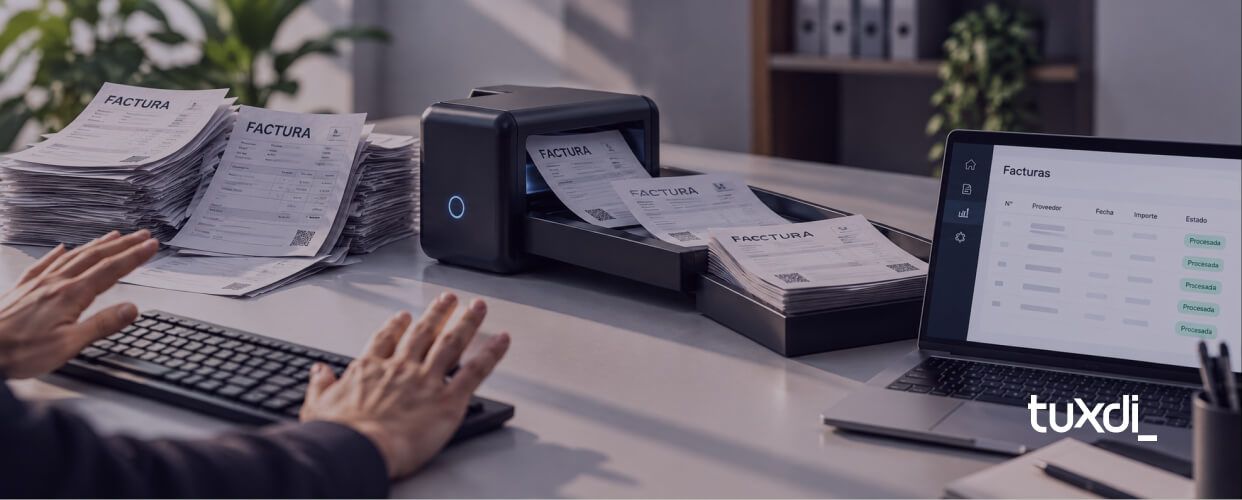
- invoice and document processing;
- customer service through WhatsApp and Instagram;
- lead follow-up and qualification;
- proposal and quotation generation;
- automated reports and alerts;
- CRM integration with other tools;
- business knowledge bases.
An interesting aspect of its proposal is that it combines low-code tools with development when the workflow requires greater customization. It may be an option to consider if: you want to automate business workflows using n8n, AI agents, and integrations with existing tools.
4. Tec5
Tec5 is an Argentine technology company with a broader offering than automation alone: it also works with infrastructure, IT services, development, and Artificial Intelligence. Within its AI solutions, it offers business process automation, intelligent agents, and integration with existing tools. The company specifically mentions connections with CRM, ERP, WhatsApp, and platforms used by Argentine companies such as Tango, Bejerman, and SAP Business One. This places it in an interesting segment: organizations that want to incorporate automation and AI without necessarily replacing their current technology infrastructure.
What solutions does it offer?
Its proposal includes:
- AI agents;
- process automation;
- document automation;
- chatbots;
- voice assistants;
- predictive models;
- systems integration;
- copilots for operations, sales, and support;
- computer vision.
Tec5 also proposes a progressive process that starts with a diagnosis, continues with a proof of concept, and then scales the solution into production. It may be an option to consider if: your organization needs automation or AI integrated with existing business systems and is looking for a provider with a broader IT offering.
5. Globant
Globant is a technology company of Argentine origin with an international presence and a different profile from the previous companies. Its process optimization offering includes Intelligent Automation, Process Mining, and operations transformation, in addition to a much broader ecosystem of technology services. Within Intelligent Automation, Globant works with systems capable of interacting with applications and executing tasks that traditionally required human intervention. Its scale and operating model mean that its proposal is particularly associated with large organizations and complex digital transformation programs.
What types of projects does it handle?
Its process optimization offering includes:
- Intelligent Automation;
- Process Mining;
- process optimization;
- operations transformation;
- automation across business systems;
- AI and data initiatives;
- large-scale technology projects.
It may be an option to consider if: you are an enterprise organization with multiple systems, departments, and processes that needs to approach automation as part of a larger technology transformation.
6. Wodes
Wodes is an Argentine agency that combines technology, marketing, Artificial Intelligence, and automation. Its automation offering includes document processing, chatbots, application synchronization, reporting, RPA, and integration with business systems. It also works with CRM, e-commerce tools, and customer service channels.
What processes can it automate?
Its services include:
- data capture and normalization;
- document processing and classification;
- automatic information extraction;
- ERP integration;
- chatbots;
- CRM integration;
- repetitive task automation;
- synchronization between applications;
- automated reporting;
- alerts and triggers;
- RPA.
Its experience within the digital and marketing ecosystem can be particularly relevant for processes related to sales, customer service, reporting, and customer acquisition. It may be an option to consider if: the automation is related to marketing, customer service, documents, reporting, or digital processes connected to CRM and other platforms.
7. AIRIS
AIRIS is an automation company based in Buenos Aires focused on connecting channels, business rules, systems, and people around operational processes. Its approach places considerable emphasis on something that is often overlooked when discussing automation: what happens when the automated flow cannot continue. Not every process can be automated end to end. There may be an exception, an integration may fail, or a decision may require human judgment. AIRIS focuses on automating repeatable steps while keeping situations that require intervention visible.
What types of automation does it develop?
Its proposal includes:
- connected workflows;
- customer service automation;
- CRM integration;
- scheduling and forms;
- payments;
- spreadsheets;
- data and reports;
- error handling;
- handoff to people when an exception occurs.
It also evaluates whether existing tools can be connected before recommending their replacement. It may be an option to consider if: you want to automate operational and administrative processes across different tools while keeping human intervention for exceptions.
What is a process automation company?
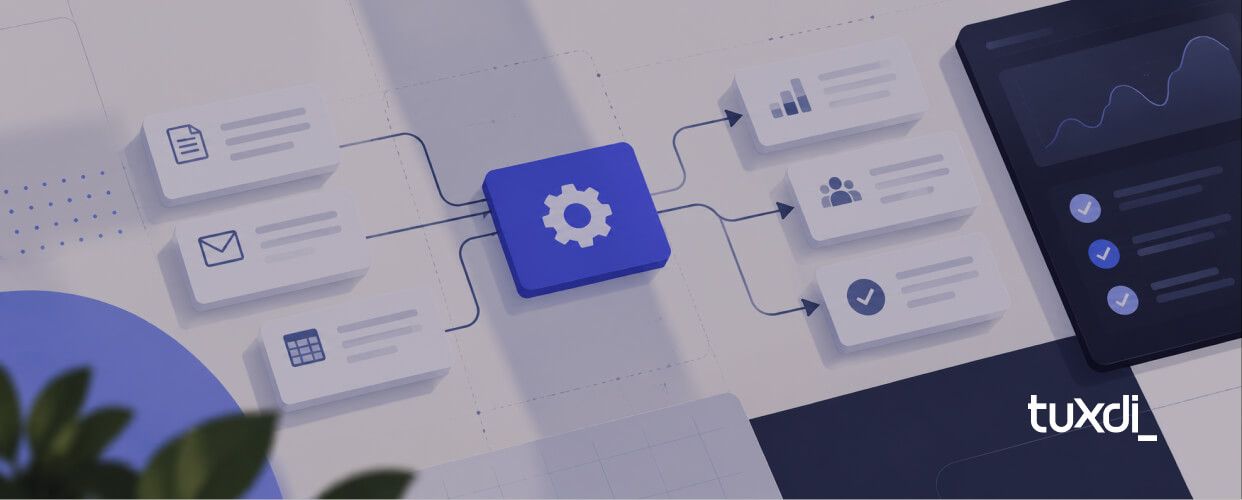
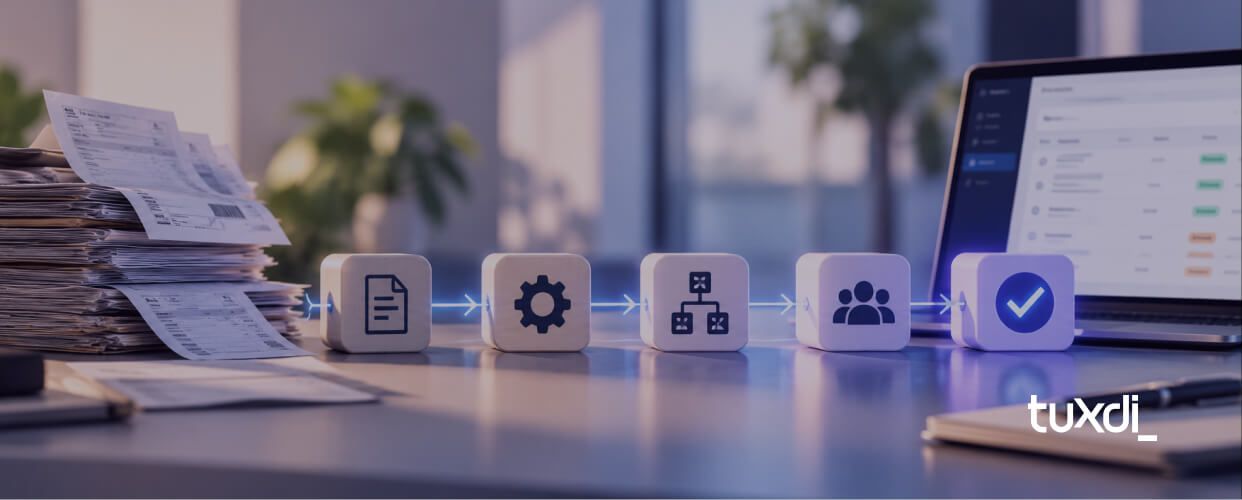
A process automation company analyzes tasks and workflows that currently require manual intervention and designs technology solutions to execute part of that work automatically. This can include something as simple as: Form → CRM → email But also much more complex processes: Document → information extraction → validation → ERP query → CRM update → report generation → exception handling That is why treating “automation” as a single category can be misleading. There are different technologies and approaches.
Types of business automation
Task automation
This is the simplest level. It aims to eliminate a specific repetitive action. For example:
- sending an email when an event occurs;
- automatically creating a task;
- copying information between applications;
- generating an alert;
- updating a record.
Tools such as Zapier, Make, n8n, or Power Automate may be sufficient for many of these scenarios.
Process automation
Instead of automating an isolated task, it connects different steps within a workflow. For example, a sales process could:
- receive a lead;
- validate their data;
- retrieve information;
- classify the opportunity;
- create it in the CRM;
- assign an owner;
- send a response;
- generate a follow-up task.
The more rules, systems, and exceptions involved, the greater the complexity usually becomes.
Systems integration
Many companies do not need to replace their software. They need their systems to communicate with each other. A CRM may need information from the ERP. An e-commerce platform may need to update inventory. An internal system may need to query an external API. APIs, webhooks, and integration services make it possible to automate that exchange of information.
RPA: Robotic Process Automation
RPA makes it possible to automate certain actions that a person performs through interfaces and systems. Historically, it has been used especially when legacy applications are involved or when suitable APIs are not available. Platforms such as UiPath or Microsoft Power Automate are part of this ecosystem.
Low-code and no-code automation
Tools such as n8n, Make, Zapier, and Power Automate make it possible to build workflows by connecting applications through visual interfaces. They are especially useful when the tools involved have good APIs and the process can be represented through relatively clear rules. But they do not eliminate the need for technical design. An automation that works in a small test may need error handling, authentication, logs, retries, permission controls, and monitoring when it goes into production.
Automation with Artificial Intelligence
AI becomes especially useful when the process contains information that cannot be handled only through deterministic rules. For example:
- interpreting an email;
- classifying an inquiry;
- extracting information from documents;
- analyzing text;
- summarizing information;
- detecting intent;
- generating a response;
- working with images;
- choosing between different actions depending on context.
Artificial Intelligence does not necessarily replace traditional automation. They often work together. AI interprets. The workflow executes.
Artificial Intelligence agents
Agents add another layer. Instead of only generating a response, they can use external tools and systems to perform actions. An agent could, for example:
- receive an inquiry;
- understand what the user needs;
- query the CRM;
- verify information in another system;
- execute an action;
- update a record;
- respond;
- hand off the case if it detects an exception.
That is why agents are beginning to play an important role in business automation.
Traditional automation vs. AI automation
One of the most common misconceptions in 2026 is assuming that automation necessarily means using Artificial Intelligence. It does not. If a company needs:
When a form is submitted, create a contact in the CRM and notify the salesperson.
it probably does not need AI. Those are clear rules. On the other hand:
When an email arrives, interpret what the customer is requesting, identify the attached documentation, extract specific information, and decide which workflow it should enter.
that is where AI may start to make sense. The right question is not: “Can we add AI to this process?” It is: “Which part of the process actually needs AI?” Adding Artificial Intelligence where a traditional rule already solves the problem correctly can add cost, complexity, and maintenance without generating an equivalent benefit.
What processes can be automated in a company?
Virtually every area can contain automation opportunities. That does not mean they should be fully automated.
Sales
Lead capture, information enrichment, CRM, opportunity assignment, follow-up, proposal generation, and sales alerts.
Administration
Data entry, record updates, document generation, reconciliations, and repetitive tasks.
Finance
Collections, invoicing, reconciliations, reports, alerts, and document processing.
Customer service
Inquiry classification, frequent responses, information retrieval, ticket updates, and handoff to operators.
Human Resources
CV entry and classification, onboarding, documentation, reminders, and internal inquiries.
Marketing
Lead capture, reporting, audience synchronization, contact classification, and campaign automation.
Operations
Orders, inventory, validations, updates between systems, alerts, and workflow coordination.
Reporting
Data extraction from different sources, processing, validation, and automatic generation of dashboards or reports.
Which processes should you automate first?
Just because a task can be automated does not mean it is a good investment. The best candidates usually share some characteristics:
- they occur frequently;
- they consume a significant amount of time;
- they are repetitive;
- they follow identifiable rules;
- they generate manual errors;
- they require copying information between systems;
- they cause delays;
- they have a measurable outcome.
Suppose a task happens twice a year and takes ten minutes. Automating it probably does not make sense. Now imagine another task that five people perform several times every day. The equation changes completely. That is why it is better to evaluate the current cost of the process first and only then think about technology.
How much does it cost to automate a process in Argentina?
There is no single price. The cost depends on the number of systems involved, available integrations, business rules, volume, exceptions, the need to use AI, and the level of reliability required. As an approximate reference for an Argentine SME:
| Level | Approximate investment |
|---|---|
| Simple MVP | USD 600–1,500 |
| Intermediate MVP | USD 1,500–4,000 |
| Advanced MVP | USD 4,000–8,000 |
| Enterprise | Custom quote |
A simple MVP could automate one specific task. An intermediate project may connect several stages and systems. An advanced automation may include multiple APIs, document processing, Artificial Intelligence, databases, complex rules, error handling, and traceability. Enterprise projects also introduce requirements such as high availability, advanced security, large volumes, legacy systems, and multiple business areas. That is why comparing proposals based only on price can be misleading. What matters is understanding what the solution includes and what problem it solves.
Should you use n8n, Make, Zapier, or develop a custom solution?
It depends on the process. No-code and low-code can be excellent alternatives. If a company needs to connect well-known tools through stable APIs and execute relatively simple rules, developing everything from scratch would probably be unnecessary. Custom development starts to make more sense when there are:
- specific business rules;
- complex integrations;
- custom interfaces;
- legacy systems;
- large volumes;
- specific permissions;
- special security needs;
- logic that exceeds the platform's capabilities;
- scalability requirements;
- complex AI processing.
And many solutions use both approaches. For example, n8n can orchestrate the workflow while a custom-developed service executes business-specific logic. So the discussion should not be “no-code vs. code.” It should be: What is the simplest architecture that correctly solves the problem?
Do I need to change my ERP or CRM to automate?
Not necessarily. In many projects, replacing current systems would even be counterproductive. If the ERP, CRM, or internal system performs its function correctly and provides integration mechanisms, it is possible to build a layer around it. For example: Existing ERP + API + automation + AI The ERP remains the core system. The new layer retrieves information, processes data, or performs specific actions. This makes it possible to add new capabilities without carrying out a full migration. The main requirement is to evaluate which integration options the current system provides: APIs, webhooks, exports, database access, or other mechanisms.
How to choose a process automation company
It is not advisable to choose a provider simply because it uses a particular tool. The fact that a company works with n8n, Make, Python, UiPath, OpenAI, or any other technology does not guarantee that it can correctly solve a process. Before hiring one, it is worth evaluating at least these aspects.
1. It understands the process before choosing the technology
A good implementation should start by understanding what happens today. Who starts the process? Which systems are involved? What rules exist? What exceptions appear? Where is time being lost? What happens when something fails? The tool should be chosen afterwards.
2. Integration capabilities
Business automation rarely lives in isolation. It may need to connect to ERP, CRM, email, WhatsApp, databases, e-commerce, APIs, or proprietary software.
3. Error and exception handling
The “happy path” is usually easy. The difficult part is deciding what happens when:
- an API does not respond;
- data is missing;
- incorrect information appears;
- a user does something unexpected;
- an operation is left halfway through.
4. Traceability
It should be possible to understand what the automation did, when it did it, and with what result. This becomes especially important in critical processes.
5. Security
Credentials, permissions, and business data should be treated as part of the design, not as an afterthought.
6. Maintenance
APIs change. Processes change. Systems change. Automation needs a strategy to evolve.
7. Measurement
Before implementation, there should be some way to determine whether the project worked. Hours saved. Errors reduced. Response time. Cost per operation. Processing capacity. Without a metric, it is difficult to know whether automation generated value.
10 questions to ask before hiring an automation company
Before moving forward with a provider, these questions can prevent many problems:
- How would you determine which part of the process should be automated first?
- Do we need AI, or can it be solved with rules?
- How will the solution integrate with our current systems?
- What happens if an API or integration stops working?
- How are exceptions handled?
- Will we be able to know which actions the automation performed?
- Who will have access to credentials and data?
- What monthly costs will the solution have in addition to development?
- Who will own the development and documentation?
- How will we measure the result?
The answers say much more about a provider than a list of technologies.
Frequently asked questions about automation companies in Argentina
What are some process automation companies in Argentina?
Companies offering automation-related services in Argentina include Tuxdi, Suris Code, Duotach, Tec5, Globant, Wodes, and AIRIS. Their approaches differ: some combine automation with software development, while others specialize in AI, workflows, RPA, or enterprise transformation.
What is the best automation company in Argentina?
There is no single company that is the right option for every project. The choice depends on the size of the organization, the systems involved, the process to be automated, the budget, and the level of customization required.
What does an automation company do?
It analyzes manual processes and designs systems to automatically execute certain tasks. It can connect applications, move information, process documents, generate reports, execute rules, use Artificial Intelligence, or coordinate complete workflows.
How much does it cost to hire an automation company?
As a reference, a simple MVP for an SME can start at around USD 600–1,500. An intermediate solution may range from USD 1,500–4,000 and an advanced one from USD 4,000–8,000. Enterprise projects usually require a specific estimate.
What tools do automation companies use?
Depending on the project, they may use n8n, Make, Zapier, Power Automate, UiPath, APIs, webhooks, Python, Node.js, databases, and Artificial Intelligence models, among other technologies.
What is the difference between RPA and process automation?
RPA usually automates actions that a person performs through applications or interfaces. Process automation is a broader concept and may include APIs, integrations, workflows, rules, custom software, RPA, and Artificial Intelligence.
Can a company be automated with n8n?
n8n can automate a large number of workflows and connect different applications. However, some projects also require custom development, specific infrastructure, databases, custom interfaces, or additional security and monitoring mechanisms.
Is Artificial Intelligence necessary for automation?
No. Many automations work better with traditional rules. AI is especially useful when the process needs to interpret text, documents, images, or unstructured information, or when decisions depend on context.
Can a process be automated without changing the current software?
In many cases, yes. If current systems provide APIs or other integration mechanisms, they can be connected to a new automation layer without replacing them.
What should an SME automate first?
It is best to start with frequent, repetitive, measurable processes that currently consume a significant amount of manual work. A limited first project makes it possible to measure results before expanding automation.
Automation does not mean replacing people: it means redesigning processes
The goal of good automation should not be to incorporate as many tools, agents, or Artificial Intelligence systems as possible. It should be to solve a specific problem. Sometimes the solution will be to connect two systems. Other times it will be to build a workflow with n8n. In another scenario, documents may need to be processed with AI. And in more complex projects, it will be necessary to build custom software around the process. That is why, before asking which tool to use, it is worth mapping the current process, identifying where manual work is generated, and defining which result you want to improve. Only then does it make sense to choose the technology and provider.
Want to know which processes you could automate in your company?
At Tuxdi, we design automation solutions, integrations, and Artificial Intelligence systems adapted to real processes. We can analyze how a process works today, identify which parts make sense to automate, and evaluate whether the solution needs an integration, workflow tools, custom development, or Artificial Intelligence. Tell us which process you would like to automate.