
Index
- What Is Legacy Software?
- Signs Your System Needs to Be Evaluated
- Maintenance Is Becoming More Time-Consuming
- Integrating New Tools Has Become Difficult
- The User Experience Is Outdated
- Modernize Your System or Start from Scratch?
- Common Mistakes When Modernizing a System
- How to Reduce Migration Risks
- What Technologies Are Commonly Used to Modernize Software?
- Conclusion
- Frequently Asked Questions
- What does Legacy Software mean?
- When should you modernize a system?
- When is it better to build new software?
- Can a system be modernized without disrupting business operations?
Every company reaches a point where the software that once fueled its growth starts becoming an obstacle.
Slow processes, complex integrations, recurring issues, and an outdated user experience are some of the most common signs that a system has fallen behind.
These types of solutions are known as Legacy Software or legacy systems.
The big question is: should you modernize it or build a new one?
The answer depends on several factors. In this article, we'll show you how to make the right decision without putting your business operations at risk.
What Is Legacy Software?
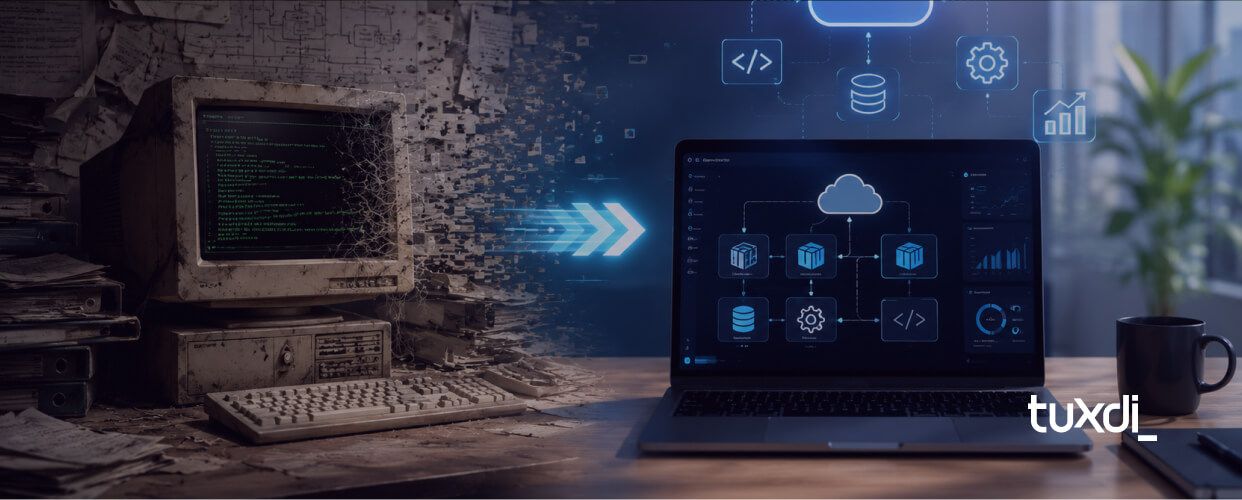
Legacy Software refers to a system that is still actively used within an organization but was built using outdated technologies or no longer meets the current needs of the business.
A legacy system isn't necessarily "old." In many cases, it's only five or six years old, but the company's growth has outpaced its capabilities.
Some common examples include:
- ERPs developed more than ten years ago.
- Internal systems built by vendors that are no longer in business.
- Applications that only run on on-premise servers.
- Platforms that cannot integrate with modern tools.
The real issue isn't the age of the software—it's the cost of continuing to maintain it.
Signs Your System Needs to Be Evaluated
Replacing an entire system isn't always necessary. However, the following situations usually indicate it's time to assess your software.
Maintenance Is Becoming More Time-Consuming
If every new feature requires modifying multiple parts of the system or fixing unexpected issues, chances are the architecture is no longer sustainable.
Integrating New Tools Has Become Difficult
Today, businesses regularly need to connect their systems with CRMs, payment platforms, AI tools, and cloud services.
If every integration turns into a lengthy development project, your software is becoming a business limitation.
The User Experience Is Outdated
Slow interfaces, inefficient workflows, and unintuitive designs directly impact employee productivity and customer satisfaction.
Modernize Your System or Start from Scratch?
There isn't a single correct answer.
The decision depends on the current state of your software, your budget, and your business goals.
| Modernize | Build from Scratch |
|---|---|
| Lower initial investment | Higher initial investment |
| Preserves existing processes | Allows a complete redesign |
| Gradual implementation | Modern architecture from day one |
| Lower operational impact | Best when the current system can no longer evolve |
In many cases, gradual modernization can extend the system's lifespan for several years.
However, when the architecture has become too limiting or maintenance costs outweigh the value the system provides, building a new platform often becomes the best long-term investment.
Common Mistakes When Modernizing a System
Many companies make rushed decisions that create even more problems.
The most common mistakes include:
- Trying to rewrite the entire system at once.
- Failing to involve users throughout the process.
- Holding onto outdated technologies out of fear of change.
- Not defining a migration strategy.
- Underestimating the impact on day-to-day operations.
Modernization should be a strategic initiative—not a reaction to a crisis.
How to Reduce Migration Risks
A successful modernization strategy is usually carried out in stages.
For example:
- Assess the current state of the system.
- Identify the most critical modules.
- Prioritize high-impact improvements.
- Modernize gradually.
- Introduce new technologies without disrupting business operations.
This approach minimizes risks while delivering value from the early stages of the project.
What Technologies Are Commonly Used to Modernize Software?
Today, many companies take advantage of modernization projects to adopt technologies that improve scalability and future integrations.
Some of the most common include:
- Microservices architectures.
- REST APIs or GraphQL.
- Cloud infrastructure.
- React and Next.js for modern user interfaces.
- Node.js or .NET for backend services.
- AI-powered integrations.
The goal isn't to use the newest technology—it's to choose the one that best supports your business objectives.
Conclusion
Legacy Software doesn't always need to be replaced.
In many situations, a well-planned modernization strategy can extend its lifespan, improve the user experience, and prepare your business for future technological challenges.
The key is making informed decisions based on the current state of your software and your company's long-term goals.
Organizations that plan these initiatives early are better positioned to reduce costs, minimize risks, and accelerate their digital transformation.
Frequently Asked Questions
What does Legacy Software mean?
Legacy Software refers to systems that are still in use but were built using outdated technologies or architectures that no longer fully meet current business requirements.
When should you modernize a system?
Modernization is recommended when the existing technology is still reliable but can benefit from improvements without replacing the entire platform.
When is it better to build new software?
Building a new solution is often the better option when maintaining the existing system costs more than developing a modern, scalable platform.
Can a system be modernized without disrupting business operations?
Yes. A phased migration strategy allows organizations to modernize their software gradually while minimizing risks and avoiding operational downtime.